







By Ashish V. Shah, Chief Product and Technology Officer, and Dr. Ajani Nimmagadda, Chief Medical Officer | Integrated Home Care Services (Integrated)
In sales conversations, in RFP responses, in calls with partners, health plans are asking a direct question: Are you aligned with the AHIP and BCBSA prior authorization reform commitments? The question is no longer hypothetical. Many of the country’s leading payers have signed on to a set of commitments with the Health and Human Services (HHS) and the Centers for Medicare & Medicaid Services (CMS), and those guidelines are already changing how care decisions get made across the healthcare ecosystem.
For Integrated Home Care Services (Integrated), the answer is straightforward. As an associate member of AHIP, Integrated is directly engaged with the industry standards shaping this reform. We’re not aligning toward these commitments. We’re enabling them, right now, for the health plan partners who delegate their home-based benefit to us. Here’s why:
Initial Gains are Meaningful—But What’s Next Will Be More Impactful
In June 2025, America’s Health Insurance Plans (AHIP) and the Blue Cross Blue Shield Association (BCBSA) announced voluntary commitments covering every major friction point in prior authorization. The pledge from more than 100 health plans includes:
- Reducing the scope of services subject to prior authorization
- Expanding electronic prior authorization with real-time decisioning and auto-approvals
- Honoring existing authorizations for 90 days when members change health plans
- And achieving 80% real-time electronic prior authorization responses via FHIR API standards by January 1, 2027.
The ripple effect is and will be far-reaching. Participating plans are projected to process 6.5 million fewer prior authorizations in 2026, an 11% reduction, including more than 15% in Medicare Advantage. Gold carding programs are expanding across the industry, and electronic prior authorization adoption continues to grow.
These are meaningful gains. And they raise a specific question for home-based care: which partners are built to deliver on them?
Why Home-Based Care Is a Distinct Challenge
Prior authorization reform has primarily targeted acute care, imaging, and specialty drugs. Home-based care requires other specific considerations. Home health, durable medical equipment (DME), long-term services and supports, private-duty nursing, and home infusion each carry their own authorization requirements, provider network dynamics, and documentation standards.
In a traditional benefit structure, health plans manage these service lines through separate vendor. That means multiple prior authorization workflows, myriad provider interactions, and several points where clinical coordination can break down. When a member changes health plans, honoring existing authorizations requires coordination across all of these service lines simultaneously, and the AHIP continuity of care commitment explicitly includes live-in home care services in its 90-day transition protections.
The clinical impact of getting this wrong is high.
A delayed authorization for a home health visit is not an administrative inconvenience. It’s a gap in post-acute recovery and a potential trip to the ED.
A lapse in DME delivery affects a member’s ability to function at home. Prior authorization reform in home-based care is a clinical transformation question, not only a compliance one.
The Transformation That Matters
Prior authorization reform isn’t about removing clinical oversight. It’s about concentrating review where it has genuine clinical value and removing friction where it doesn’t. That’s been the operating principle behind Integrated’s approach to home-based benefit management from the beginning: appropriate utilization, timely access, and accountability that influences more positive outcomes.
The AHIP and BCBSA commitments have aligned the broader industry around a standard that Integrated already operationalizes for health plan partners every day. The platform is actively accelerating access to the right in-home benefits and deeply integrating into payer partner ecosystems. The clinical infrastructure is managing complex cases and ensuring no member falls through the cracks. As 2027 approaches, health plans with a unified, tech-forward and FHIR-ready delegated in-home care partner are in a different position than those who aren’t. That distinction is going to matter.
How Integrated Answers Each Commitment
Integrated manages the full home-based benefit on a delegated basis across home health, DME, LTSS, private duty nursing, and home infusion, through a single accountable platform and partnership. That unified structure is what makes the following possible.
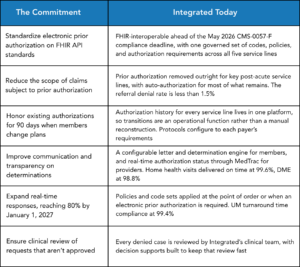
The commitments are new. The operating model behind them is not.
To learn how IHCS’s delegated home care management model enables your prior authorization reform commitments, connect with us at ihcscorp.com.